Things to Do in Murano: Furnaces, the Glass Museum, the Dragon's Bones and a Walk Round the Island
The best things to do in Murano are to watch glass being blown in a furnace, visit the Glass Museum, see the 12th-century mosaic floor and the “dragon’s bones” in the basilica of Santi Maria e Donato, find the Bellini altarpiece in San Pietro Martire, and walk the island’s canals from the Colonna stop to the lighthouse. Most visitors see only the showrooms along one canal and leave within an hour; with two or three hours and a plan, Murano is one of the most rewarding islands in the lagoon. This guide covers each sight with its hours and prices, a walking route that links them, and tips for fitting Murano into a day with Burano.
Murano at a glance
- Where: Murano lies about 1.5 km north of Venice and measures about 1.5 km across.
- Shape: Murano is made up of seven islands linked by bridges over eight channels, with its own Grand Canal.
- Why glass: Venetian glassmaking was concentrated on Murano by law from 1291, because glass furnaces often caught fire.
- Getting there: Line 3 (Diretto Murano) runs Piazzale Roma – Ferrovia – Murano, and lines 4.1, 4.2 and 12 call too. From the railway station to Fondamente Nove or Murano takes about 25 minutes.
- Time needed: two to three hours for the main sights; half a day with lunch.
The top things to do
| Sight | What it is | Cost | Time |
|---|---|---|---|
| A furnace demonstration | A master glassmaker at work | Often a small fee | About 20 minutes |
| Glass Museum | The history of Murano glass | €15.00 (reduced €7.50) | An hour or more |
| Santi Maria e Donato | Byzantine basilica, mosaic floor | €3.50 contribution | 30 minutes |
| San Pietro Martire | Parish church with Bellini | Check at the door | 20 minutes |
| Rio dei Vetrai and the Ponte Longo | The glassmakers’ canal | Free | A stroll |
| Campo Santo Stefano | Clock tower and the glass comet | Free | A few minutes |
| The lighthouse | Murano’s landmark from the water | Free (outside only) | A few minutes |
Watch glass being made
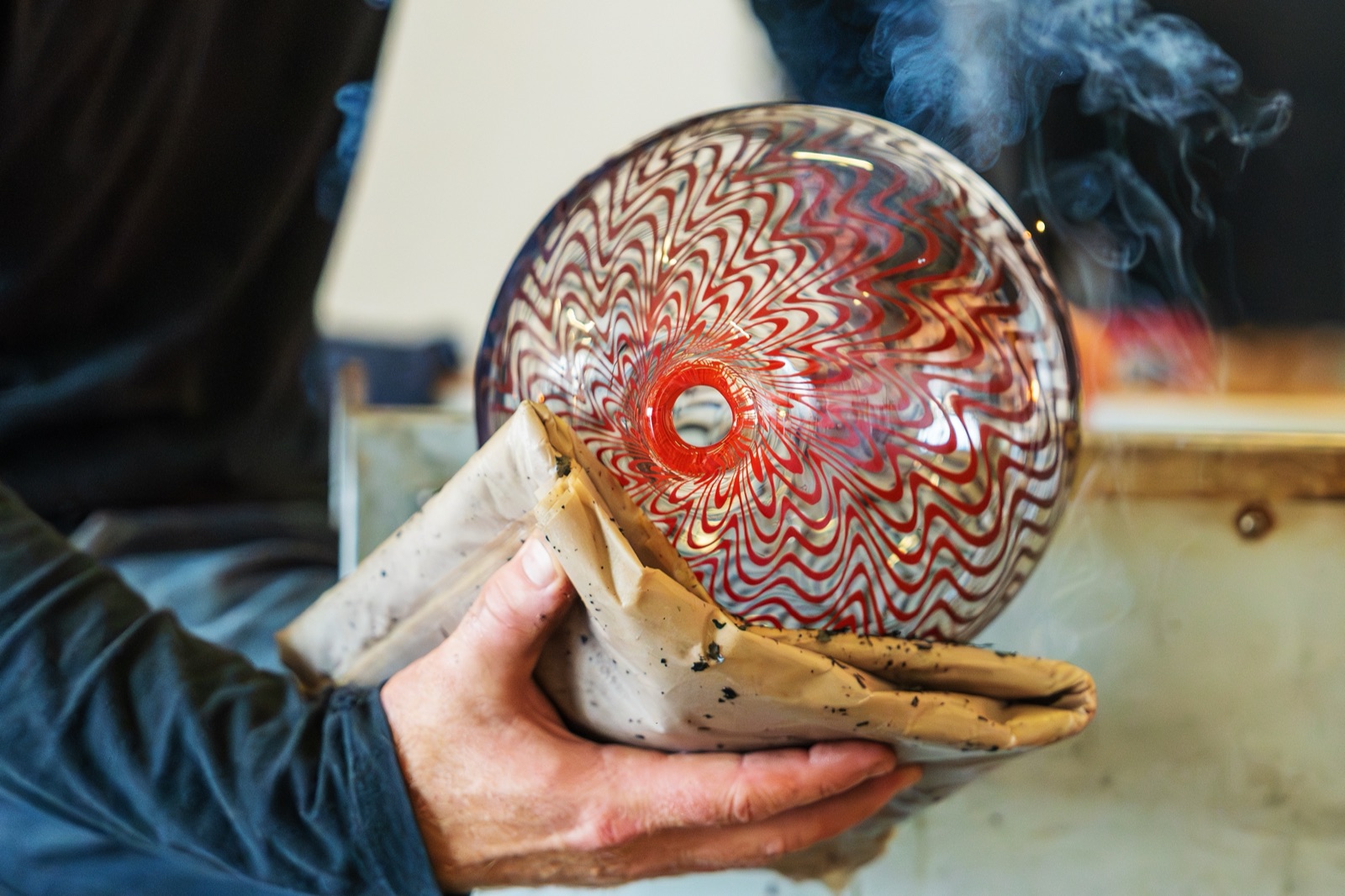
This is why most people come, and it is worth doing properly. Murano has many glassworks, some medieval and most open to the public, and many Murano workshops show simple glassworking for a fee. In a few minutes a master takes a glowing gather of glass from the furnace, at around 1,000 °C, and turns it into a vase or a horse with tongs and a few turns of the blowpipe. The master sits on the scagno, a three-legged bench typical of Mediterranean glassmaking.
Tips for a good demonstration:
- Go in the morning or early afternoon, when the furnaces are working at full pace.
- Choose a working furnace, not a shop front. Demonstrations inside a real factory are more interesting than a bench in a showroom.
- Book if you want certainty. A 20-minute factory demonstration with a EUR 10 shop credit can be booked in advance, and the boat tour with a guide and a glass-factory visit includes one.
- You do not have to buy. A polite thank-you is enough after a free demonstration.
The Murano glass guide explains the techniques you will see, from cristallo to millefiori.
The Glass Museum
The Museo del Vetro is the key to understanding everything else on the island.
- The building: The Glass Museum is housed in the Palazzo Giustinian, and a museum since 1861, in the former seat of the diocese of Torcello.
- The collection: The Glass Museum holds the world’s largest historical collection of Murano glass, with pieces from the 15th to the 20th century.
- Hours: The Glass Museum opens every day: 1 April–31 October 10:00–18:00 (last admission 17:00), 1 November–31 March 10:00–17:00 (last admission 16:00).
- Tickets: €15.00 full price and €7.50 reduced (children aged 6 to 14, students aged 15 to 25, visitors over 65). An audio guide (MUVE app) is included in the Glass Museum ticket price.
- Combined ticket: The Island Museums ticket covers the Glass Museum, the Lace Museum and the Torcello Museum for €20 (reduced €10), valid 3 months with one admission to each.
Allow at least an hour, and go before the furnace demonstration if you can: you will understand the master’s every move better.
Santi Maria e Donato: the mosaic floor and the dragon’s bones
Murano’s great church is the island’s most beautiful building and, for many visitors, its biggest surprise.
What to see
- The floor. Its mosaic floor of marble and coloured glass paste dates from around 1140. The floor covers more than 500 square metres and is made of porphyry, serpentine and other stones, laid in geometric patterns and animals: look for the eagle, the peacock and the griffins.
- The dragon’s bones. Behind the altar hang four rib bones, each over 1 metre long, said to be those of the dragon. Legend says Saint Donatus slew it; the bones may in fact belong to large prehistoric animals.
- The east end. The finest side of the church is the colonnaded east end, facing a canal, so walk round the outside before you go in.
- The saint. Saint Donatus was added to the dedication in 1125, when his body was brought from Cephalonia.
Hours and entry
- Opening: The basilica of Santi Maria e Donato is open to visitors Monday to Saturday 9.00–16.45 and on Sunday 12.00–16.45.
- Contribution: Entry is by a contribution towards restoration and upkeep: €3.50 full price. The reduced contribution is €1.50, for students aged 12 to 25; under-12s enter free.
- Groups: Groups of more than 25 must book.
- Respect services: the basilica is a parish church; visits stop during Mass.
It is a short walk from the Murano Museo and Navagero stops, and next to the Glass Museum, so the two make a natural pair.
San Pietro Martire and Bellini
Near the Colonna end of the Rio dei Vetrai stands Murano’s other great church. San Pietro Martire, founded in 1348 with a Dominican convent, burned down in 1474 and was rebuilt by 1511. It is one of Murano’s two main parish churches, and the church of San Pietro Martire has works by Giovanni Bellini, one of the great painters of Renaissance Venice. It has the chapel of the Ballarin family, built in 1506.
It is easy to miss among the showrooms, but stepping in from the busy canal into the quiet nave is one of the pleasures of Murano. Look for the Bellini paintings, the reason art lovers make the detour.
Walk the Rio dei Vetrai and cross the Ponte Longo
The Rio dei Vetrai, the “glassmakers’ canal”, runs from the Colonna stop into the heart of the island, lined with furnaces, showrooms and small bridges. It is the busiest part of Murano and the one most visitors see.
At its end you reach Murano’s own Grand Canal and its main bridge. Murano’s Ponte Longo ‘Lino Toffolo’, a 19th-century single-span metal bridge of 33 m across the island’s Grand Canal, reopened on 7 August 2026 after restoration. From the top there are long views along the canal in both directions, and on the far side the Glass Museum and the basilica are a few minutes’ walk away.
Palazzo da Mula and Murano’s lost villas
It is hard to imagine today, but Murano was once a summer retreat. In the 15th century Murano became a resort for Venetians and palaces were built there. One survives: Palazzo da Mula, on the south bank of the Canale degli Angeli near the Ponte Vivarini, is the last remnant of the villas Venetians built on Murano in the 15th and 16th centuries. Its Gothic windows face the canal. It now houses municipal offices, and its main floor is used for cultural events, so you will usually see it from outside.
Campo Santo Stefano and the glass comet
The small square by the clock tower is Murano’s meeting place. Here stands one of the island’s modern symbols: in Campo Santo Stefano stands Simone Cenedese’s blue Comet Glass Star, made for Christmas 2007 from hundreds of hand-worked glass pieces and lit from within in the evening. It is best seen at dusk. Busa alla Torre, also known as Busa da Lele, is a Murano restaurant serving fresh fish and local dishes, right on the square, if you need lunch.
The lighthouse
From the water, Murano’s landmark is its lighthouse, by the Murano Faro stop. Murano’s first lighthouse, of 1912, was a metal tower on piles; it was replaced in 1934 by the present 35-metre stone tower, white with two black bands. The lighthouse is not open to visitors, but the waterfront around it is a quiet place to watch the boats, and the Faro stop is where you change to line 12 for Burano.
San Michele: the cemetery island next door
Between Murano and Venice lies a walled island of cypresses. San Michele has been Venice’s principal cemetery since 1807, and Mauro Codussi’s church of San Michele in Isola, of 1469, was the first Renaissance church in Venice. Igor Stravinsky and Sergei Diaghilev are buried in the Orthodox section of San Michele cemetery, and Ezra Pound is buried in the Protestant section.
- Getting there: Line 4.2 calls at the Cimitero stop (San Michele) between Murano Colonna and Fondamente Nove, so it is an easy stop on the way back.
- Hours: San Michele cemetery opens 7:30–16:30 in winter and 7:30–18:00 in summer.
The Venice Glass Week
If your dates are flexible, Murano is at its liveliest in September. The Venice Glass Week returns from 11 to 19 September 2027 for its eleventh edition, with exhibitions, open studios and events across Venice and Murano.
Buying glass
Much of the “Murano glass” sold around Venice is not made on the island. The Vetro Artistico Murano trademark is established and regulated by Veneto Regional Law no. 70 of 1994, and it is the easiest way to be sure. Buying from a furnace you have just watched at work is another. Ask about shipping for anything large or fragile; most serious workshops arrange it.
A little history to carry with you
Knowing a few facts makes a walk round Murano far more interesting.
- A privileged trade. By the 14th century glassmakers could wear swords and enjoyed immunity from prosecution by the Venetian state. The price was freedom: glassmakers were forbidden to leave the Republic, though many took the risk and set up furnaces abroad.
- An island of glass. At the end of the 16th century, 3,000 of Murano’s 7,000 inhabitants worked in glass in some way.
- The great invention. In the 15th century Murano’s glassmakers created cristallo, almost transparent and considered the finest glass in the world, and cristallo is thought to have been created by Angelo Barovier (1405–1460).
- Decline and survival. After the fall of the Republic in 1797, an industrial crisis began for the city, but the furnaces never went out. About 260 companies still operated on Murano in 2016, employing 1,100 people.
The boat stops, and which one to use
| Stop | Best for | Lines |
|---|---|---|
| Colonna | Rio dei Vetrai, furnaces, San Pietro Martire | 4.1, 4.2 |
| Museo | Glass Museum, Santi Maria e Donato | 4.1, 4.2 |
| Navagero | The basilica, the far side of the Grand Canal | 4.1, 4.2 |
| Faro | The lighthouse; change for Burano | 4.1, 4.2, 12 |
On a time ticket you can hop between stops, but remember that every change of boat or bus needs a new validation. The getting there guide covers every line and ticket.
A walking route round Murano
This loop links the main sights in about two to three hours with stops.
- Start at Colonna, the first Murano stop on lines 4.1 and 4.2, and walk along the Rio dei Vetrai, stopping for a furnace demonstration.
- San Pietro Martire for the Bellini, on the same canal.
- Campo Santo Stefano and the glass comet, a short detour.
- Cross the Ponte Longo over Murano’s Grand Canal.
- The Glass Museum, then the basilica of Santi Maria e Donato next door.
- Back along the Grand Canal past Palazzo da Mula, towards the lighthouse and the Faro stop.
- From Faro, line 12 on to Burano, or lines 4.1, 4.2 or 3 back to Venice.
Lunch on Murano
Murano’s restaurants are simpler than Burano’s. In 2012 two sisters-in-law turned an old bakery in the heart of Murano into the AcquaStanca osteria, at Fondamenta Manin 48, and Busa alla Torre on Campo Santo Stefano is a long-standing trattoria. See where to eat on Burano and Murano for hours and closing days.
Murano with children
- The furnace is the highlight: short, hot, loud and magical.
- The Glass Museum has a reduced ticket for children aged 6 to 14, and the bright colours keep younger visitors interested.
- The dragon’s bones in the basilica make a good story.
- On the boats, children under 6 travel free.
Murano on a rainy day
Murano is the best island in the lagoon for bad weather. The furnaces, the Glass Museum, the basilica, San Pietro Martire and the showrooms are all indoors, and the walks between them are short. Keep Burano, which is mostly outdoors, for a dry day.
Fitting Murano into a day
Murano is the first island on line 12 from Fondamente Nove and the obvious first or last stop on a day in the northern lagoon. Many visitors do Murano in the morning and Burano in the afternoon; going to Burano first and stopping at Murano on the way back often means fewer crowds on both. The best time to visit guide explains why, and Murano or Burano helps if you can only do one. For a guided half day with the glass included, see the tours page.
Frequently asked questions
What is there to do in Murano besides glass?
The basilica of Santi Maria e Donato with its 12th-century mosaic floor and “dragon’s bones”, San Pietro Martire with its Bellini, Palazzo da Mula, the lighthouse, and San Michele cemetery on the way back to Venice.
How long do you need in Murano?
Two to three hours covers a furnace demonstration, the Glass Museum and the basilica; add an hour for lunch.
Can you watch glassblowing in Murano for free?
Many workshops charge a small fee for a demonstration. A booked 20-minute demonstration includes a EUR 10 shop credit.
How much does the Murano Glass Museum cost?
€15.00 full price and €7.50 reduced; the Island Museums ticket for €20 also covers the Lace Museum and the Torcello Museum.
What are the dragon’s bones in Murano?
Four large rib bones hanging behind the altar of Santi Maria e Donato, said to be from the dragon slain by Saint Donatus; they may come from large prehistoric animals.
Is the Murano lighthouse open to visitors?
No. It is a working lighthouse, seen from the waterfront and from the boats.