Murano Glass: History, Techniques, Furnace Visits and the Glass Museum
For more than seven centuries, the island of Murano has meant one thing above all: glass. The name alone evokes chandeliers, jewel-coloured vases, delicate goblets and the glow of a furnace. Yet much of what visitors see on a short trip — a quick demonstration, a row of shops — only hints at how extraordinary the history is, and how much there is to understand in a single piece of glass.
This guide explains why glassmaking settled on Murano, how the island came to dominate European glass, the techniques that give Murano glass its character, what really happens in a furnace demonstration, how to get the most from the Glass Museum, and how to recognise genuine Murano glass when you buy it.
Murano at a glance
Murano lies about 1.5 km north of Venice and measures about 1.5 km across. It is made up of seven islands linked by bridges over eight channels, so it feels like a small Venice of its own, with a grand canal, fondamenta walkways and bridges. It is close enough for a morning visit and compact enough to explore on foot.
Why the glass is on Murano
The law of 1291
Glass was made in Venice long before it was made on Murano. The earliest archaeological evidence of a glassworks in the lagoon comes from Torcello, from the 7th–8th century. By the 13th century, Venice itself had many furnaces — and that was a problem.
Venetian glassmaking was concentrated on Murano by law from 1291, because glass furnaces often caught fire; moving them to the island removed much of the risk of a disastrous fire in the city, then largely built of wood. Moving the furnaces across the water protected Venice, and it had a second advantage: with the industry gathered on one island, the Republic could watch over its glassmakers and their secrets.
The first products
Early products included beads, glass for mosaics, jewellery, small mirrors and window glass. Exports began in the century after 1291, and Murano became famous first for glass beads and mirrors; aventurine glass was invented there, and it later became known for chandeliers.
The golden age
Cristallo
The great breakthrough came in the Renaissance. In the 15th century Murano’s glassmakers created cristallo, almost transparent and considered the finest glass in the world. Cristallo is thought to have been created by Angelo Barovier (1405–1460). Clear, thin and light, it could be blown into forms of astonishing delicacy, and it made Murano the centre of luxury glass in Europe.
Lattimo
Around the same time, the glassmakers answered another fashion. Lattimo, an opaque milk-white glass, was invented on Murano around 1450 to imitate Chinese porcelain. Painted with enamels, it gave European buyers something close to the prized porcelain of the East.
Mirrors
Murano’s glassmakers later became Europe’s best mirror makers. Venetian mirrors, with their clear glass and elaborate frames, were among the most coveted luxury objects of their age.
An island of glassmakers
At its height, glass was not just an industry on Murano; it was the island. At the end of the 16th century, 3,000 of Murano’s 7,000 inhabitants worked in glass in some way.
Privilege and secrecy
The Republic treated its glassmakers as a precious resource, with rewards and restrictions to match.
- By the 14th century glassmakers could wear swords and enjoyed immunity from prosecution by the Venetian state. Their daughters could marry into the wealthiest families of Venice.
- Glassmakers were forbidden to leave the Republic, though many took the risk and set up furnaces abroad, sometimes as far as England and the Netherlands.
The secrecy explains much of Murano’s long lead. The recipes, the furnace techniques and the skills of the masters were passed down within families and workshops, and for centuries rivals could not match them.
Decline and revival
No monopoly lasts forever. As glassmakers left and other centres learned the craft, Murano’s dominance faded. After the fall of the Republic in 1797, an industrial crisis began for the city, and the old protections of the guilds disappeared.
The revival began with the founding of the Glass Museum in 1861, which gathered the island’s records and its historic glass, and the furnaces gradually returned to full work. In the 20th century, artists and designers began working with the furnaces, and new techniques were born: sommerso, with layers of contrasting colour, was born on Murano in the late 1930s.
Today, Murano has many glassworks, some medieval and most open to the public, and glassmaking is still the island’s defining craft.
A short timeline
- 7th–8th century: the earliest known glassworks in the lagoon, on Torcello.
- 1291: glassmaking concentrated on Murano by law, to protect wooden Venice from fire.
- 14th century: glassmakers allowed to wear swords and protected from prosecution, but forbidden to leave.
- 15th century: cristallo, the clearest glass in the world, attributed to Angelo Barovier.
- Around 1450: lattimo, the milk-white glass that imitates porcelain.
- First half of the 16th century: filigrana, glass laced with white or coloured threads.
- End of the 16th century: 3,000 of Murano’s 7,000 inhabitants work in glass.
- 1797: the fall of the Republic and the start of an industrial crisis.
- 1861: the Glass Museum is founded.
- Late 1930s: sommerso, the layered colour glass of modern Murano.
- 1994: the Vetro Artistico Murano trademark is regulated by regional law.
Techniques to recognise
Knowing a few techniques turns a walk past shop windows into a lesson in glass. Murano developed or refined clear glass, enamelled glass, aventurine with threads of gold, millefiori, lattimo milk glass and glass imitation gemstones.
Cristallo
Colourless, transparent glass, thin and light. The finest cristallo pieces seem almost weightless.
Lattimo
Opaque milk-white glass, invented to imitate porcelain, often painted with enamels.
Aventurine
Glass glittering with what look like flecks of gold. Aventurine’s golden flecks are in fact tiny copper crystals, grown inside the glass as it cools. It was invented on Murano and remains one of its most distinctive materials.
Filigrana
Filigree glass was invented on Murano in the first half of the 16th century. Thin rods of white or coloured glass are embedded in clear glass, forming spirals, nets and twists. The finest pieces look as if they were wrapped in lace.
Millefiori and murrine
Glass canes built up from concentric layers of colour, often in flower or star patterns. Millefiori canes are cut into slices called murrine, which are then fused together into bowls, beads and jewellery. Look for the tiny flowers in cross-section.
Enamel
Enamel decoration came to Venice from the East in the last decade of the 13th century. Coloured glass powders are painted onto the surface and fused in a kiln, giving the painted goblets and plates of the Renaissance.
Sommerso
Thick glass in layers of contrasting colour, one “submerged” inside another. Born in the late 1930s, it is one of the signature looks of modern Murano glass.
Inside a furnace
A glassblowing demonstration is the moment most visitors remember. Knowing what you are watching makes it far more rewarding.
The furnace
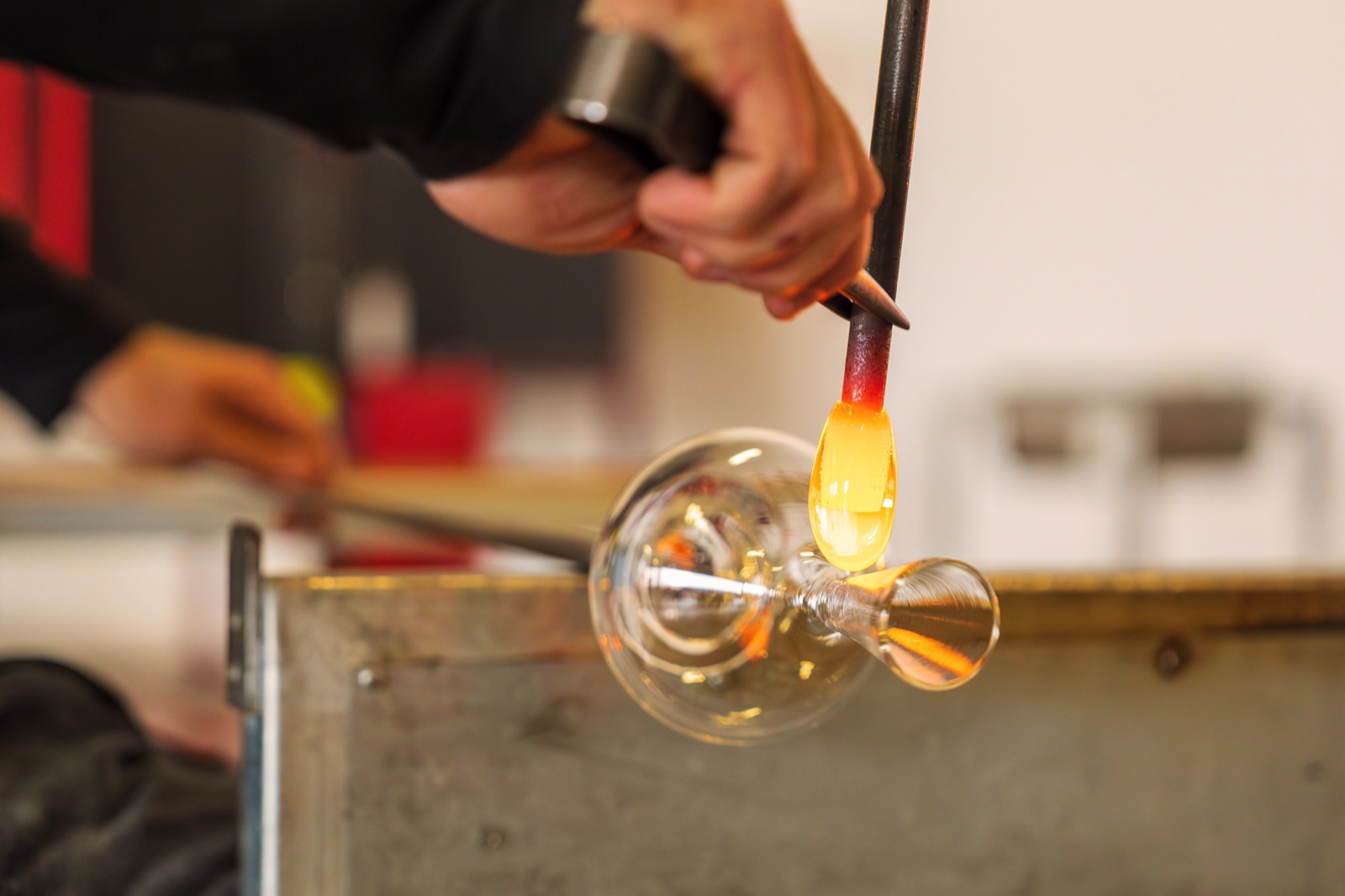
The heart of every workshop is the furnace. Glass is taken from the furnace at around 1,000 °C, glowing orange and soft like honey. Inside, the raw materials melt in refractory pots, and the heat never really stops.
The tools
- The blowpipe is a long metal tube used to blow air into the molten glass. The master gathers a blob of glass on its end and inflates it.
- The master sits on the scagno, a three-legged bench typical of Mediterranean glassmaking, rolling the pipe along its arms to keep the glass centred.
- Pincers and shears shape, pull and cut the hot glass.
- A solid iron rod holds the piece while the blowpipe end is worked.
What happens in a demonstration
A typical demonstration shows a master turning a gather of molten glass into a small object — a vase or a small animal figure — in a few minutes. You will see the glass taken from the furnace, reheated again and again as it cools and stiffens, blown, pulled with pincers and cut with shears. The speed and confidence are the point: every movement has been repeated thousands of times.
Where to watch
- Many Murano workshops show simple glassworking for a fee.
- The 20-minute factory demonstration on Murano shows a master glassblower at work and a sculpting demonstration, with a EUR 10 shop credit. Getting to Murano is up to you.
- The boat tours to Murano and Burano include a glassblowing demonstration or a glass-factory visit as part of the trip.
The Glass Museum
To understand what you have seen in the furnace, visit the Glass Museum (Museo del Vetro).
The building and the collection
The museum is housed in the Palazzo Giustinian, the old residence of the bishops of Torcello. It has been a museum since 1861, in the former seat of the diocese of Torcello. The Glass Museum holds the world’s largest historical collection of Murano glass, with pieces from the 15th to the 20th century, and its samples range from Egyptian times to the present day, placing Murano in the long history of glass.
Hours and tickets
- Opening: every day: 1 April–31 October 10:00–18:00 (last admission 17:00), 1 November–31 March 10:00–17:00 (last admission 16:00).
- Tickets: €15.00 full price and €7.50 reduced (children aged 6 to 14, students aged 15 to 25, visitors over 65).
- Audio guide: an audio guide (MUVE app) is included in the Glass Museum ticket price.
- Families: a reduced ticket for every paying member of groups of two adults with at least one young person up to 16.
- Combined: the Island Museums ticket covers the Glass Museum, the Lace Museum and the Torcello Museum for €20 (reduced €10), valid 3 months with one admission to each.
How to visit
Allow at least an hour. A good approach is to visit the museum after a demonstration: having watched the glass being worked, you will appreciate far better the skill in a Renaissance goblet or a filigree bowl. Look for examples of each technique in this guide — cristallo, lattimo, aventurine, filigrana, murrine and enamel — and follow how styles changed over the centuries.
Beyond glass
Murano has more than furnaces.
- Santa Maria e San Donato. The church of Santa Maria e San Donato is known for its 12th-century Byzantine mosaic floor and is said to hold the bones of the dragon slain by Saint Donatus. The floor is one of the treasures of the lagoon, and it rewards a slow look.
- San Pietro Martire. The church of San Pietro Martire has works by Giovanni Bellini, one of the great painters of Renaissance Venice.
- The Faro. The lighthouse by the Murano Faro vaporetto stop is the island’s landmark from the water.
Buying Murano glass
Murano glass is famous, and the name is widely borrowed. A few pointers help you buy with confidence.
The trademark
The Vetro Artistico Murano trademark is established and regulated by Veneto Regional Law no. 70 of 1994. It certifies glass made on the island by the companies that belong to it. When a piece matters to you, ask whether it carries the trademark and a certificate.
Tips
- Buy from workshops and shops that make their own glass, where you can often see the furnace.
- Ask where and how a piece was made. Genuine makers are proud to explain their techniques.
- Be wary of prices that seem too good for handmade glass, especially for beads and small souvenirs.
- Ask about shipping before you buy a larger or fragile piece.
Getting to Murano
Murano is the easiest island to reach from Venice.
- Line 12 from Fondamente Nove, which continues to Burano.
- Lines 4.1 and 4.2 around Venice, calling at Murano.
- Line 3 (Diretto Murano) from Piazzale Roma and the station.
A single ticket valid 75 minutes costs €9.50; a 24-hour pass is €25, and it pays off if you continue to Burano. See How to get to Murano and Burano for the lines, tickets and connections in detail.
Glass-focused tours
Boat tour with a guide and a glass-factory visit. A morning or afternoon boat to Murano and Burano with a guide on board (commentary in five languages) and a glass-factory visit. About 4.5 hours.
Murano, Burano and Torcello half-day boat tour. A live glassblowing demonstration on Murano and up to 1.5 hours on each island. About 4.5 hours.
Guided tour by private boat. A private boat to a Murano glass workshop, then Burano. About 5 hours.
Murano glass-factory demonstration. A 20-minute visit with a EUR 10 shop credit, if you are going to Murano on your own.
The tours page lists them all with live prices.
A morning on Murano
- Early: vaporetto to Murano Faro, before the tour boats arrive.
- First: a furnace demonstration, to see the glass worked hot.
- Then: the Glass Museum, opening at 10:00, to see what the masters have made over the centuries.
- Late morning: the mosaic floor of Santa Maria e San Donato and a walk along the canals and shops.
- Midday: continue on line 12 to Burano, or return to Venice.
Frequently asked questions
Why is glass made on Murano?
Venetian glassmaking was concentrated on Murano by law from 1291, because furnaces often caught fire and Venice was then largely built of wood. Gathering the industry on the island also helped the Republic protect its secrets.
Can I watch glassblowing on Murano?
Yes. Many workshops show simple glassworking for a fee, a 20-minute factory demonstration can be booked on its own, and the boat tours include a glassblowing demonstration or glass-factory visit.
How much is the Murano Glass Museum?
€15.00 full price and €7.50 reduced. The Island Museums ticket, covering the Glass, Lace and Torcello museums, costs €20 (reduced €10).
What are the Glass Museum’s opening hours?
Every day. From 1 April to 31 October, 10:00–18:00 with last admission at 17:00; from 1 November to 31 March, 10:00–17:00 with last admission at 16:00.
How do I know Murano glass is genuine?
Look for the Vetro Artistico Murano trademark, regulated by Veneto Regional Law no. 70 of 1994, and buy from workshops that make their own glass.
What is aventurine?
Glass with glittering flecks that look like gold but are in fact tiny copper crystals. It was invented on Murano.