Best Time to Visit Murano and Burano: Seasons, Crowds and Events Month by Month
Murano and Burano weather this week
Burano (1 m)
The five-day forecast for Burano, updated through the day.
Forecast data from MET Norway (CC BY 4.0), summarised by day.
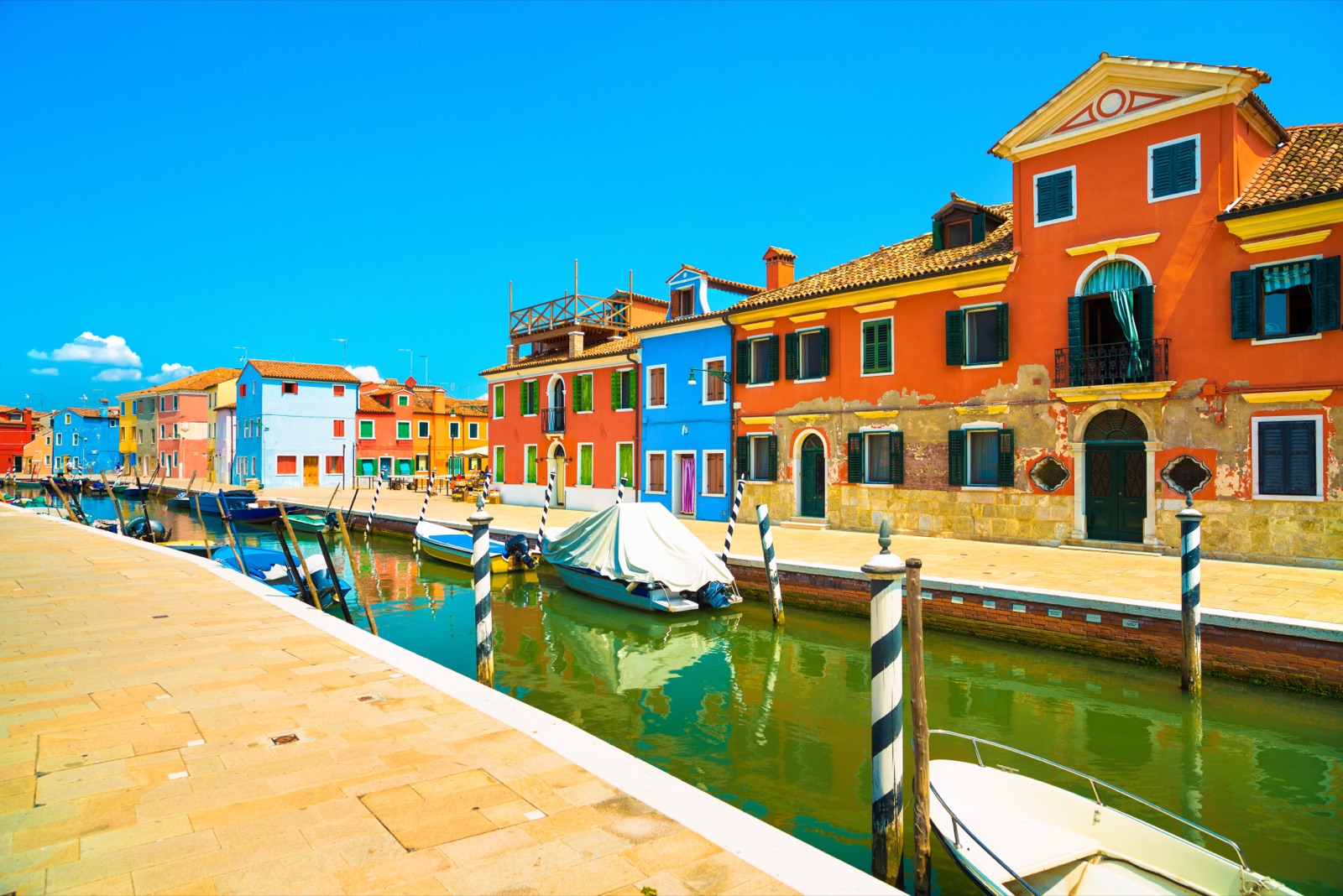
The best time to visit Murano and Burano is spring or autumn, on a weekday, starting early in the morning. April, May, late September and October give you mild days, long museum hours and boats that are busy but not packed, while a weekday start before the tour boats arrive gives you Burano’s painted streets at their quietest. Summer weekends are the most crowded, midday is the busiest time of day, and winter is quiet but short-houred, with fog that can slow the boats. This guide explains how the seasons, the days of the week, the hours of the day, the island festivals and Venice’s access fee fit together, so you can choose your day with your eyes open.
The short answer
- Best months: April, May, late September and October. Long opening hours, comfortable walking weather and lagoon food in season.
- Best days: Tuesday to Thursday. The Lace Museum is closed on Mondays, and Friday to Sunday carry the access-fee days in 2027.
- Best time of day: the first boats of the morning, or the last two hours of the afternoon on Burano.
- Busiest: summer weekends, Easter, the late-April and early-June holiday bridges, and the middle of the day all year.
- Quietest: November to February on weekdays, when you trade crowds for short museum hours and the chance of fog.
For the forecast and the monthly averages, see the Murano and Burano weather page. The rest of this guide is about everything the weather does not tell you.
How the islands work in time
Murano and Burano are reached only by water, so timing a visit means timing the boats. Line 12 runs from Fondamente Nove via Murano, Mazzorbo, Torcello and Burano to Treporti and Punta Sabbioni, and it runs all year. From the railway station to Fondamente Nove or Murano takes about 25 minutes, plus about 45 minutes on to Burano. That ride is the same in January and in July; what changes is how many people are on it, how long the museums stay open, and what the lagoon is doing.
Two other things set the rhythm of a day out here:
- The tour boats. The half-day boat tours leave Venice in the morning and in the afternoon. The Murano, Burano and Torcello half-day boat tour lasts about 4.5 hours and gives up to 1.5 hours on each island, and the boat tour with a guide and a glass-factory visit runs as a morning or afternoon departure. When the tour groups are on Burano, the main streets around Piazza Galuppi fill; when they leave, the island empties again.
- The day visitors. Most people come from Venice for the day and go back before dinner. Burano in the evening, after the last big wave has left, is a different place.
Season by season
| Season | Crowds | Museum hours | Lagoon and food |
|---|---|---|---|
| Spring (March to May) | Rising; busy at Easter and on holiday bridges | Summer hours from 1 March (Torcello) and 1 April (Glass Museum) | Castraure artichokes, moeche crabs, the Vogalonga |
| Summer (June to August) | Highest, especially weekends | Longest | Hot, bright, little shade on Burano |
| Autumn (September to November) | Falling after mid-September | Summer hours until 31 October | Glass Week, Regata di Burano, moeche again, first fogs |
| Winter (December to February) | Lowest, except Carnival | Shortest | Fog, high water, Christmas lights on Murano |
Spring: the best all-round season
From March the days lengthen and the museums move onto their longer hours. On Torcello, from 1 March to 31 October the basilica opens 10:30–18:00 (last entry 17:30) and the bell tower 10:30–17:30 (last entry 17:00), and on Murano the Glass Museum opens 10:00–18:00 from 1 April. The line 12 timetable is in force from 22 April 2026, so check the current timetable if you are planning a tight connection to Torcello.
Spring is also the lagoon’s best eating season. The artichoke season in Venice starts at the end of April with the castraure, the tender first bud, and the harvest runs into the second half of June. Castraure are available fresh for only a few days, so they are a stroke of luck rather than a plan. Moeche are lagoon green crabs caught while moulting, in spring (April and May) and autumn (October to November), when for a few hours their shells are soft; restaurants on Burano fry them when they can get them. More on both in the guide to eating on Burano and Murano.
The catch is that spring is also when Venice starts charging day visitors again (see the access-fee section below), and Easter, the 25 April holiday and the 1 May holiday bring big Italian crowds.
Summer: long days, long queues
Summer gives you the longest opening hours and the latest light, but also the most people. Burano is small, almost entirely built up and mostly in full sun, and the main canal-side streets are slow going in the middle of the day. Murano’s glass shops and furnaces are indoors and shaded, which is why many visitors do Murano at midday and Burano later.
Two practical summer rules:
- Go early. Board one of the first line 12 boats from Fondamente Nove and you reach Burano before the tour boats do.
- Stay late. The evening light on the painted houses is better than the midday light, and the island is quieter. Because the route is long, line 12 boats have toilets on board, and a night line (Notturno Laguna Nord) serves Fondamente Nove – Sant’Erasmo – Burano – Punta Sabbioni, so you are not stranded if you stay for dinner.
Autumn: the second sweet spot
From mid-September the crowds thin, the heat breaks and the light softens, and the summer museum hours run until 31 October. Autumn is also the season of two island events (below) and of the second moeche season in October and November.
The trade-off arrives in November. From 1 November to the end of February the basilica opens 10:00–17:00 (last entry 16:30) and the bell tower 10:00–16:45 (last entry 16:00), and the Glass Museum moves to 10:00–17:00, last admission 16:00. Fog and high water become more likely, and both affect the boats.
Winter: quiet, short and sometimes foggy
Winter is the time to see Burano almost empty on a weekday. The colours are just as bright in low winter sun, and you can walk the side canals without meeting anyone. Museums keep shorter hours, though: the Lace Museum on Burano opens 10:00–16:00 with last entry at 15:30, is closed on Mondays, and in winter you will want to arrive by late morning to fit in the Lace Museum and Torcello in one day.
The one crowded stretch is Carnival. The Venice Carnival 2027 runs from 23 January to 9 February 2027. The events are in Venice itself, but Carnival brings large numbers to the city, and the boats from Fondamente Nove fill up accordingly.
Fog, high water and the boats
The lagoon matters more than the air temperature. In fog (visibility below 150 m) and high water (above 85 cm) the boat services are changed, which can mean slower or diverted runs. Burano itself sits very low: Burano rises no more than 1 m above sea level.
If a high tide is expected, you will hear it. The city’s high-water alert speakers are installed in Venice, along the Venetian coast and on the islands, and after the opening siren, the number of rising tones gives the tide expected: one long tone for +110 cm, two for +120 cm, three for +130 cm and four for +140 cm or more.
In practice:
- Fog is most likely on still mornings from late autumn to winter. Leave slack in your plans and do not book a tight onward connection the same evening.
- High water is a seasonal event, usually for a few hours around the peak of the tide. If an alert sounds, give it a few hours or spend the time indoors in a museum.
- The weather page shows the live forecast for Burano and explains what each kind of weather means for the boats.
The 2027 access-fee calendar
Venice charges day visitors an access fee on selected days. In October 2026 the city approved 72 access-fee days for 2027, against 60 in 2026. The trial began in 2024 with 29 days, rising to 54 in 2025 and 60 in 2026.
- When: The 2027 calendar runs from Good Friday, 26 March, to the Ferragosto Sunday, 15 August 2027, mostly Friday-to-Sunday weekends plus some holidays and bridge days.
- Continuous blocks: There are two continuous periods, 23 April to 2 May and 28 May to 6 June 2027.
- Hours: In 2027 the fee applies from 8:30 to 16:30, half an hour longer than in 2026.
- Price: The 2027 amount is capped at €10; exclusions, exemptions and booking arrangements were still to be set. The 2027 arrangements will be announced by 31 December 2026.
What does it mean for Murano and Burano? In the 2026 trial, it applied to the historic city of Venice and not to the minor islands of the lagoon, and guests staying overnight in the municipality’s accommodation are exempt but must register on the portal. Most visitors, though, reach the islands from the historic city, by way of the station or Fondamente Nove, so on a fee day you would normally need to pay or register for the city part of your trip. Check the rules for 2027 once they are published, and if you have a choice of days, a Tuesday to Thursday in spring or September avoids the fee days altogether.
Days of the week
The day you choose matters almost as much as the month.
- Monday: The Lace Museum is closed on Mondays, and several Burano restaurants close too. A good day for Murano, not for Burano.
- Tuesday to Thursday: the quietest days, with every museum open. Note that Venissa’s restaurant on Mazzorbo is closed on Tuesdays and Wednesdays, according to the Michelin Guide, and Trattoria da Romano on Burano closes on Tuesdays.
- Friday to Sunday: the busiest days, and in 2027 most access-fee days fall on these days.
- Sunday: on Murano, the basilica of Santi Maria e Donato opens later for visitors, from 12.00.
Time of day
| Time | Burano | Murano |
|---|---|---|
| Early morning | Quiet streets, soft light, shops opening | Furnaces starting work, few visitors |
| Late morning | Tour groups arrive; Lace Museum busiest with demonstrations | Demonstrations and shops busy |
| Midday to mid-afternoon | Busiest; restaurants full | Busy but indoors and shaded |
| Late afternoon | Tour boats gone, light warming | Quieter; Glass Museum last entry |
| Evening | Almost empty, lit windows, dinner | Very quiet |
Two details are worth planning around:
- Lace demonstrations are in the morning. Lacemakers demonstrate the techniques in the museum in the mornings, so if you want to see lace being made, be on Burano before lunch.
- Furnace demonstrations run through the working day. Many Murano workshops show simple glassworking for a fee, and they keep working hours, so Murano is the better choice for the middle of the day. The Murano glass guide explains what you will see.
Events through the year
The Vogalonga (May)
The Vogalonga is a rowing festival, not a race. The 50th Vogalonga, a non-competitive rowing event over a course of about 30 kilometres, took place on 24 May 2026. Its route passes San Francesco del Deserto, Burano and Mazzorbo, then Murano, before finishing on the Grand Canal, and checkpoints are set up along the route on Burano and in the Rio di Cannaregio. The start is at 9:00, marked by a cannon shot, and participation is capped at about 8,000 people or 2,000 boats.
For a visitor, it is a spectacular morning to be on Burano and watch thousands of boats row past, but a poor day to rely on smooth boat connections. The date moves each year, so check the organisers’ site.
The Sant’Erasmo artichoke festival (May)
Sant’Erasmo’s violet artichoke festival is traditionally held on the second Sunday of May at the Torre Massimiliana. Sant’Erasmo is half an hour by vaporetto from Fondamente Nove, and the island is the market garden of the lagoon, so the festival pairs naturally with a spring day in the northern lagoon.
The Regata di Burano (September)
Burano is an island of rowers, and the season ends here. The Regata di Burano, traditionally the return match of the Regata Storica, was rowed on Sunday 20 September 2026 and closed the Venetian rowing season. In 2026 the first race started at 15:00, and the last race was the men’s two-oar gondola race, with nine crews. If you are in Venice in late September, a Sunday afternoon on Burano’s waterfront with the regatta is one of the most local things you can do.
The Venice Glass Week (September)
The Venice Glass Week returns from 11 to 19 September 2027 for its eleventh edition, with events across Venice and Murano. It is a good week for anyone interested in glass, with open studios and exhibitions, but Murano is busier than usual.
Christmas on Murano
In December, Murano’s Campo Santo Stefano has its own landmark: Simone Cenedese’s blue Comet Glass Star, made for Christmas 2007 from hundreds of hand-worked glass pieces and lit from within in the evening. A winter afternoon on Murano ending at dusk by the comet is a gentle alternative to the summer crowds. The guide to things to do in Murano has more.
Month by month
- January: very quiet on weekdays; short hours; fog likely. Carnival starts late in the month in 2027.
- February: Carnival crowds in Venice until 9 February 2027, then quiet again.
- March: summer hours on Torcello from 1 March; access-fee days start on 26 March 2027.
- April: the Glass Museum’s summer hours from 1 April; castraure from the end of the month; Easter and the 25 April holiday are busy.
- May: moeche, castraure and the artichoke festival; the Vogalonga; busy weekends.
- June: long days and growing crowds; the access-fee block runs to 6 June 2027.
- July: hot and busy; access-fee weekends.
- August: the busiest weeks around Ferragosto; the 2027 fee days end on 15 August.
- September: the best late-summer month; Glass Week and the Regata di Burano.
- October: quieter, mild, moeche again, last month of summer hours.
- November: winter hours from 1 November; fog and high water more likely.
- December: quiet weekdays and the lit glass comet on Murano.
How to beat the crowds in any season
- Reverse the flow. Most visitors go to Murano first and Burano second. Take line 12 straight to Burano first thing, then stop at Murano on the way back.
- Use Mazzorbo. Burano is linked to Mazzorbo by a bridge, and the Mazzorbo stop is often quieter than Burano’s main pier.
- Walk away from the main canal. The side streets of Burano are just as colourful and far less crowded.
- Time your lunch. Book a table for an early or late lunch rather than queuing at the peak.
- Consider a tour at the quiet end of the day. An afternoon tour lands you on Burano as the morning groups leave; the tours page compares the options.
A quick plan for each season
- Spring: line 12 to Burano at opening time, the Lace Museum and its lacemakers, lunch with castraure or moeche, Torcello in the afternoon, Murano on the way back.
- Summer: Murano’s furnaces and Glass Museum in the cool of the morning, a late lunch on Mazzorbo, Burano for the evening light, back on a late boat.
- Autumn: a full three-island day while the summer hours last; or, on the regatta Sunday in September, an afternoon on the waterfront.
- Winter: a late-morning start, Burano and the Lace Museum by early afternoon, Murano at dusk; skip Torcello if fog is forecast.
If you are still deciding between the two islands, Murano or Burano compares them side by side, and the guide to getting to Murano and Burano covers every line and ticket.
Frequently asked questions
What is the best month to visit Burano?
May and late September are the best all-round months: mild weather, long museum hours, lagoon food in season and fewer people than in high summer. October is a close third.
What time of day is Burano least crowded?
Early morning, before the half-day tour boats arrive, and late afternoon into the evening, after most day visitors have gone back to Venice.
Is it worth visiting Murano and Burano in winter?
Yes, if you accept shorter hours and the chance of fog. The islands are at their quietest, and Murano’s glass comet is lit in the evenings around Christmas.
Do I pay the Venice access fee to visit Murano and Burano?
In 2026 the fee applied to the historic city, not to the minor islands. Most visitors pass through the historic city on the way, so on a fee day you would normally need to pay or register for that part. The 2027 rules are due by 31 December 2026.
Which day should I avoid?
Monday for Burano, because the Lace Museum is closed, and summer weekends in general, because they are the busiest days of the year.
When is the Regata di Burano?
In September, at the end of the rowing season; in 2026 it was rowed on Sunday 20 September, from 15:00.