Murano or Burano? How to Choose, and Whether Each Island Is Worth It
If you can only visit one island, choose Burano for colour, photographs and a village atmosphere, and Murano for glass, craft and an easy half day close to Venice. Burano is the more striking place to walk around; Murano is the more interesting place to learn something. Murano is about 1.5 km from Venice and takes a couple of hours; Burano is further out in the lagoon and deserves at least half a day. The good news is that you rarely have to choose: the same boat line serves both, and most visitors see both in a single day. This guide compares the two islands point by point, says who each one suits, and shows how to combine them without rushing.
The two islands in one table
| Murano | Burano | |
|---|---|---|
| Known for | Glass furnaces, the Glass Museum, chandeliers | Painted houses, lace, the Lace Museum |
| Distance from Venice | About 1.5 km north | About 7 kilometres |
| Time by vaporetto | About 25 minutes from the station | About 45 minutes more beyond Murano |
| Size | Seven islands joined by bridges | A small village of five original islands |
| Feel | A working town with shops and factories | A fishing village, crowded by day |
| Main museum | Glass Museum, €15.00 | Lace Museum, €7.00 |
| Time needed | Two to three hours | Three hours to half a day |
| Best for | Craft, history, rainy days | Photographs, walking, lunch by a canal |
Murano in brief
Murano lies about 1.5 km north of Venice and measures about 1.5 km across. Murano is made up of seven islands linked by bridges over eight channels, so it feels like a small version of Venice, with its own Grand Canal and its own long bridge.
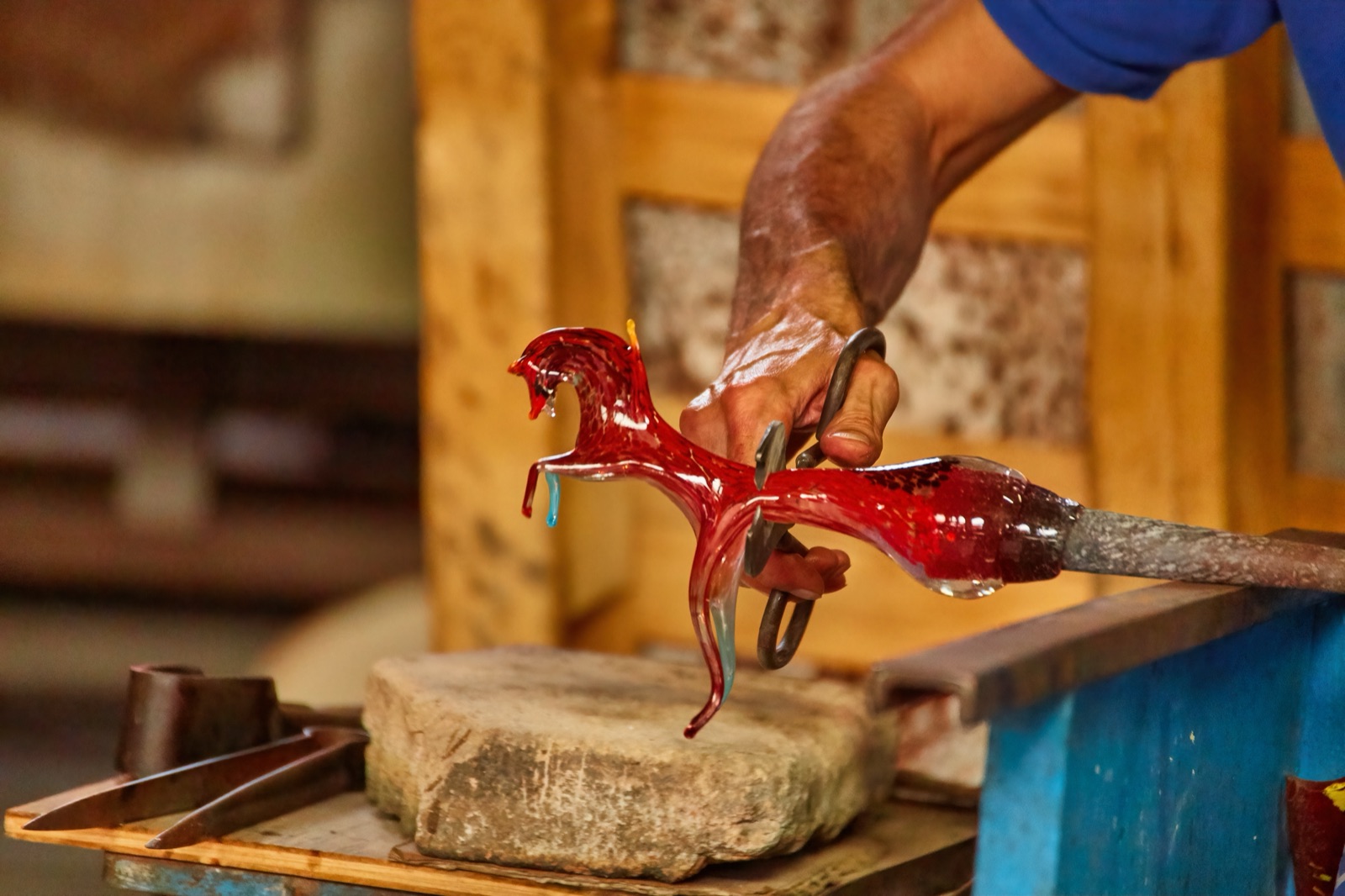
Its identity is glass. Venetian glassmaking was concentrated on Murano by law from 1291, because glass furnaces often caught fire; moving them to the island removed much of the risk of a disastrous fire in the city, then largely built of wood. Murano has many glassworks, some medieval and most open to the public, and many Murano workshops show simple glassworking for a fee. About 260 companies still operated on Murano in 2016, employing 1,100 people.
The main things to see:
- A furnace demonstration. The master shapes molten glass in front of you in a few minutes. The Murano glass guide explains the techniques and tools.
- The Glass Museum. The Glass Museum holds the world’s largest historical collection of Murano glass, with pieces from the 15th to the 20th century, and the Glass Museum is housed in the Palazzo Giustinian.
- The basilica of Santi Maria e Donato. The church of Santa Maria e San Donato is known for its 12th-century Byzantine mosaic floor and is said to hold the bones of the dragon slain by Saint Donatus.
- San Pietro Martire, where the church of San Pietro Martire has works by Giovanni Bellini.
There is more on all of these in things to do in Murano.
Burano in brief
Burano is 7 kilometres from Venice, about a 45-minute vaporetto trip from St Mark’s. Burano has about 2,800 residents, and Burano is historically divided into five sestieri, matching the five original islands.
Its identity is colour. Burano’s coloured houses were once home to fishermen and lacemakers, and house colours follow a system: an owner who wants to repaint must ask the authorities, who say which colours are permitted for that lot. The result is a whole village painted in neighbouring blocks of blue, red, yellow and green.
The main things to see:
- The painted streets and canals, best away from the main canal and early or late in the day.
- The Lace Museum. The Lace Museum documents five centuries of Venetian lace-making through around 200 original examples, and lacemakers demonstrate the techniques in the museum in the mornings.
- Piazza Galuppi. Piazza Baldassare Galuppi is Burano’s only square; the Lace Museum and the town hall stand on it.
- San Martino. The church of San Martino has a leaning bell tower and a Crucifixion by Giambattista Tiepolo painted in 1727.
- Mazzorbo, over the bridge, with its vineyard: two minutes’ walk from the Burano vaporetto stop, just over the bridge to Mazzorbo, is the Venissa estate, a walled vineyard open to the public.
The Burano and Torcello guide covers the houses, the lace and the museum in depth.
Which island suits you?
Choose Murano if…
- You are interested in how things are made. Watching glass blown and shaped is the most memorable thing on either island for many visitors.
- You have only two or three hours. Murano is close enough to fit between lunch and dinner in Venice.
- It is raining or very hot. Furnaces, showrooms and the Glass Museum are indoors.
- You want to buy something special. Glass is Murano’s trade; the island’s own trademark helps you buy the real thing (more on this below).
- It is a Monday. The Lace Museum is closed on Mondays, while the Glass Museum opens every day.
Choose Burano if…
- You want photographs. Every street and canal on Burano is a picture, in any light.
- You want a slower day. Burano and neighbouring Mazzorbo reward wandering, a long lunch and an evening by the water.
- You love food. Burano is the home of risotto di gò and of the bussolai biscuits, and the lagoon restaurants are here and on Mazzorbo (see where to eat on Burano and Murano).
- You want to add Torcello. Line 9 shuttles between Burano and Torcello, and the quiet island with the oldest cathedral in the lagoon is only a few minutes away.
Travelling with children
Both work well. Murano’s furnaces hold children’s attention, and the demonstration is short. Burano offers open space, boats to watch and Mazzorbo’s green paths. Children under 6 travel free on the vaporetto, and at the Glass Museum the reduced ticket covers children aged 6 to 14.
What each island costs
Neither island charges admission; you pay for boats, museums and food.
- The boat: A single vaporetto ticket valid 75 minutes costs €9.50; a 24-hour pass is €25, 48 hours €35 and 72 hours €45. If you plan to visit all the northern lagoon islands, a day ticket is the cheaper choice.
- Murano: The Glass Museum (Museo del Vetro) on Murano costs €15.00 full price and €7.50 reduced. The basilica asks a contribution: €3.50 full price. A furnace demonstration in a workshop is often a small fee.
- Burano: Lace Museum: €7.00 full price, €3.50 reduced.
- Both, plus Torcello: The Island Museums ticket covers the Glass Museum, the Lace Museum and the Torcello Museum for €20 (reduced €10), valid 3 months with one admission to each.
If you plan to see the Glass Museum and the Lace Museum, the combined ticket costs less than the two museums bought separately.
How long to spend on each
- Murano: two to three hours. A furnace demonstration, the Glass Museum, the basilica and a walk along the main canal fit comfortably into a morning.
- Burano: three hours to half a day. Enough for the Lace Museum, the painted streets, lunch and a walk over to Mazzorbo. Add two hours for Torcello.
- Both: a full day by vaporetto, or about 4.5 hours on a boat tour.
A tour spends less time on each island: the Murano, Burano and Torcello half-day boat tour gives up to 1.5 hours on each island, which is enough for highlights but not for the museums.
Is Murano worth visiting?
Yes, if glass interests you even a little. The furnaces are a living tradition more than seven centuries old, the Glass Museum holds the largest historical collection of it, and the basilica’s mosaic floor is one of the treasures of the lagoon. Murano is less photogenic than Burano and more commercial along its main canals, so it disappoints people who expect a second Burano. Treat it as a craft town, not a postcard, and it rewards you.
Buying glass
Much of the glass sold around Venice is not made on Murano. The Vetro Artistico Murano trademark is established and regulated by Veneto Regional Law no. 70 of 1994, and it is the simplest way to know that a piece was made on the island. Buying at a furnace you have just watched at work is another.
Is Burano worth visiting?
Yes, for almost everyone. Even at its busiest, Burano is unlike anywhere else in the lagoon, and its colours are just as bright in winter as in summer. The main disappointment is crowding in the middle of the day, which you can avoid by arriving early or staying late (see the best time to visit). The further you walk from the main canal and the Lace Museum, the more Burano feels like a village where people live, because it is.
Burano and lace today
Lace is Burano’s history more than its present industry. Few now make lace the traditional way, because it is extremely time-consuming and therefore expensive. If you want to buy genuine handmade lace, expect to pay accordingly; the Lace Museum shows what the real thing looks like.
Murano and Burano compared on the details
| Murano | Burano | |
|---|---|---|
| Opening days | Glass Museum every day | Lace Museum closed Mondays |
| Museum hours (summer) | 10:00–18:00, last admission 17:00 | 10:00–16:00, last entry 15:30 |
| Best light for photographs | Not the main reason to go | Early morning and late afternoon |
| Rain | Good: mostly indoors | Poor: mostly outdoors |
| Lunch | Simple trattorias | Seafood trattorias and Mazzorbo |
| Evening | Very quiet | Quiet, beautiful, a few restaurants |
How to see both in one day
Murano and Burano lie on the same line, so combining them is easy. Line 12 runs from Fondamente Nove via Murano, Mazzorbo, Torcello and Burano to Treporti and Punta Sabbioni. Line 3 (Diretto Murano) runs Piazzale Roma – Ferrovia – Murano; from Murano Faro, line 12 continues to Burano.
A plan that works in most seasons:
- Morning: line 12 from Fondamente Nove straight to Burano, ahead of the crowds. The Lace Museum when it opens at 10:00 and the painted streets.
- Midday: lunch on Burano or over the bridge on Mazzorbo.
- Afternoon: line 12 back to Murano. A furnace demonstration and the Glass Museum before it closes.
- Late afternoon: lines 4.1, 4.2 or 3 back to Venice, or line 12 to Fondamente Nove.
Remember that every change of boat or bus needs a new validation, which is another reason a day pass usually makes sense. The getting there guide has every line, stop and ticket.
Doing both by tour
If you would rather not plan any of this, a half-day boat tour visits both islands with a glass demonstration included:
- Murano, Burano and Torcello half-day boat tour: a guided boat from several Venice boarding points, a live glassblowing demonstration on Murano and up to 1.5 hours on each island; Torcello is an option.
- Boat tour with a guide and a glass-factory visit: a morning or afternoon boat with a guide on board and a glass-factory visit.
- Murano glass-factory demonstration: if you are going to Burano on your own but want a booked furnace visit on Murano, a 20-minute factory demonstration with a EUR 10 shop credit can be booked by itself.
The tours page lists every option with live prices.
Murano, Burano or Torcello?
Torcello is the third island most people consider. Torcello was first settled in 452 and is called the parent island from which Venice was populated, and the Cathedral of Santa Maria Assunta, founded in 639, is the oldest cathedral in the Venetian Lagoon. It is green, quiet and nearly empty compared with its neighbours. If you have a full day, add it to Burano; if you have half a day and love history more than colour, it can even replace Murano.
On foot: what each island is like to walk
Murano is spread out. Its seven islands are joined by bridges, and the main sights sit along two canals: the Rio dei Vetrai, lined with furnaces and showrooms from the Colonna stop, and Murano’s own Grand Canal, crossed by the Ponte Longo. Murano’s Ponte Longo ‘Lino Toffolo’, a 19th-century single-span metal bridge of 33 m across the island’s Grand Canal, reopened on 7 August 2026 after restoration, so the walk from the furnaces to the Glass Museum and the basilica is direct again. Expect to cross several bridges with steps on a loop of the island.
Burano is compact. You can walk from the vaporetto stop to Piazza Galuppi in a few minutes, and the whole village in under an hour without stopping. The difficulty is not distance but people: in the middle of the day the main street and the canal-side paths near the square are slow. The quiet side canals are only a street or two away.
For both islands, wear comfortable shoes, carry water in summer, and remember that the bridges have steps.
Accessibility
Neither island is fully step-free, but both are flat between the bridges. On the boats, outside the wheelchair space, pushchairs and prams must be folded, so plan for that if you are travelling with small children. Burano’s main route from the boat stop to the square is level for most of the way, and Mazzorbo’s waterfront path is flat. On Murano, each crossing between the islands is a stepped bridge, so check your route before you set out.
In the evening
Most visitors leave both islands by late afternoon. Murano becomes very quiet once the shops and furnaces close, and there is little reason to stay unless you are eating or sleeping there. Burano in the evening is one of the loveliest places in the lagoon: the canals are still, the windows light up and the colours glow in the last light. If you can stay for an early dinner, Burano is the island to stay on, and a night line (Notturno Laguna Nord) serves Fondamente Nove – Sant’Erasmo – Burano – Punta Sabbioni, so getting back is possible.
A decision in one paragraph
If you have two hours, go to Murano. If you have half a day, go to Burano. If you have a full day, do both, Burano first. If it is raining, Murano. If it is Monday, Murano. If you want the photograph everyone takes home, Burano. And if you have a full day and like quiet places, add Torcello and come back on a late boat.
Frequently asked questions
Which is better, Murano or Burano?
Burano is better for colour, photographs and a relaxed village atmosphere; Murano is better for glass, craft and a short trip. Most visitors enjoy Burano more, but Murano is the more interesting place to learn something.
Can I visit Murano and Burano in one day?
Yes. Both are on line 12, so a full day by vaporetto covers both comfortably, with time for lunch. A half-day boat tour covers both in about 4.5 hours.
How long do you need on Burano?
At least three hours, half a day if you want the Lace Museum, lunch and Mazzorbo. Add two hours for Torcello.
How long do you need on Murano?
Two to three hours: a furnace demonstration, the Glass Museum and the basilica.
Which island should I visit first?
Burano first, early, to beat the crowds, then Murano on the way back to Venice.
Is there anything free to do?
Walking Burano’s streets and Murano’s canals is free, and many workshops let you watch glassworking for a small fee. The museums and the basilica charge.