Burano and Torcello: Painted Houses, Lace and the Oldest Cathedral in the Lagoon
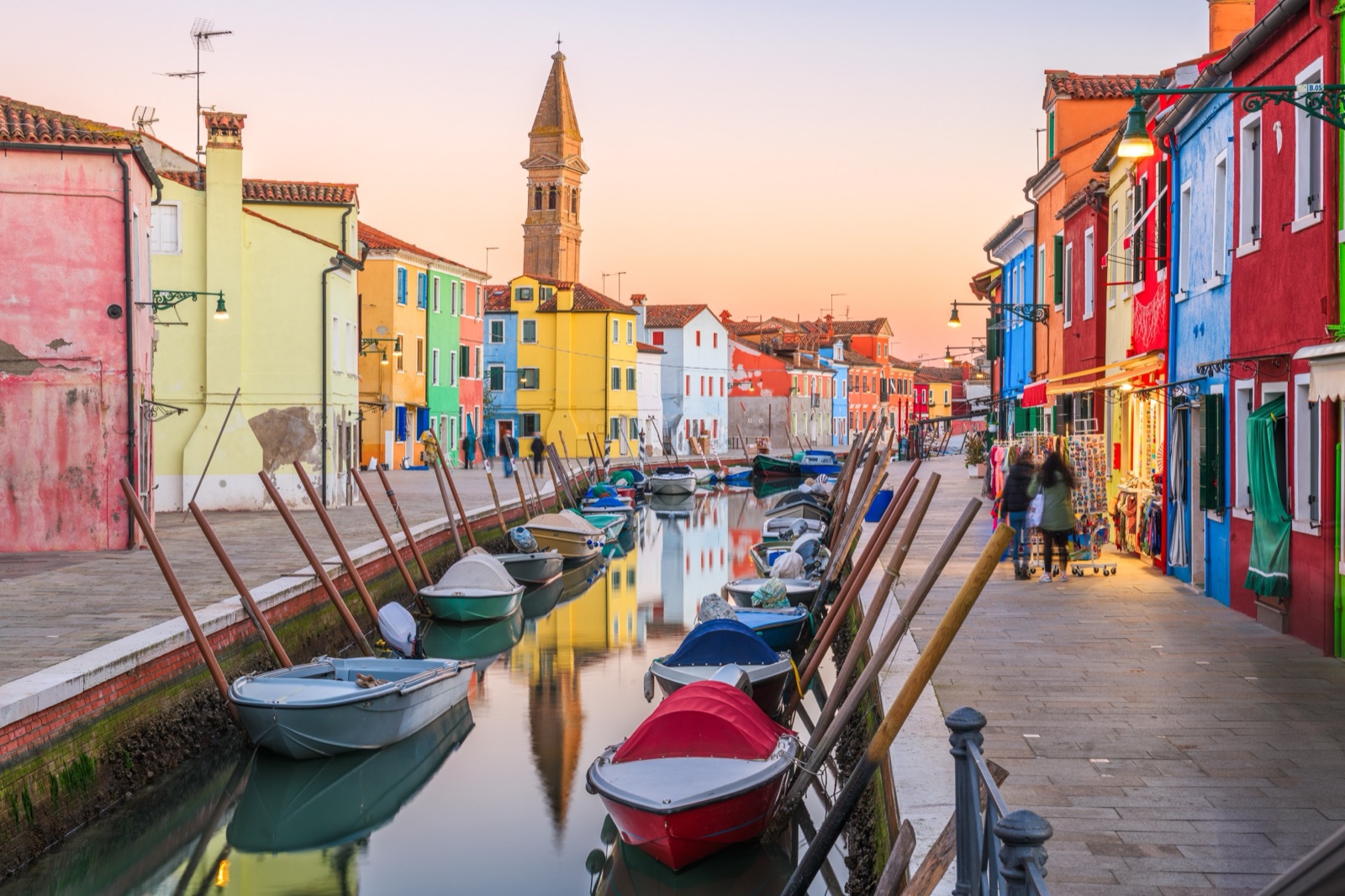
At the far end of the northern lagoon, a short hop apart, lie two islands that could hardly be more different. Burano is small, crowded and dazzlingly colourful, a fishing village of painted houses and lace. Torcello, a few minutes away by boat, is green, quiet and almost empty, with a great Byzantine cathedral standing among the fields — the last trace of a town that was once more important than Venice.
Seen together, they make one of the most rewarding days in the Venetian lagoon. This guide covers what to see on each island, the history behind the colours and the lace, the Lace Museum and the cathedral with their hours and tickets, how to travel between them, and how to plan the day.
Burano at a glance
- Burano is 7 kilometres from Venice, about a 45-minute vaporetto trip from St Mark’s.
- Burano has about 2,800 residents, and it is still a lived-in village, not an open-air museum.
- Burano is historically divided into five sestieri, matching the five original islands, joined by bridges and filled canals.
- Burano is linked to Mazzorbo by a bridge, so its quiet neighbour is only a short walk away.
The painted houses
Burano’s houses are its signature: rows of small homes in bright blue, yellow, pink, green and red, reflected in the canals. Almost every visitor comes to see them.
Fishermen and lacemakers
Burano’s coloured houses were once home to fishermen and lacemakers. The island lived from the lagoon and from the needle, and the modest two- and three-storey houses were built for working families. The tradition of strong colour is part of that working-class identity.
How the colours are chosen
The colours are not left to chance. House colours follow a system: an owner who wants to repaint must ask the authorities, who say which colours are permitted for that lot. That is why the island keeps its patchwork of bright neighbouring colours, with no two adjacent houses quite the same.
Seeing them well
- Walk away from the main canal. The streets and side canals away from the busiest route are just as colourful and far quieter.
- Go early or late. The light is softer and the crowds thinner before the tour boats arrive and after they leave.
- Remember these are homes. Residents live behind those doors and windows; take photographs from the street and respect their privacy.
Burano lace
Burano’s other claim to fame is lace, and its story is one of near-extinction and revival.
Rise and decline
Burano rose in importance in the 16th century, when its women began making needle lace. Burano lace became one of the most sought-after luxuries in Europe. Lace exports declined in the 18th century and the craft revived only in 1872, when a lacemaking school opened.
The Lace School
The revival was the work of one institution. The Lace Museum opened in 1981 in the historic Burano Lace School, founded in 1872 by Countess Andriana Marcello. The school trained generations of lacemakers and kept the technique alive into the 20th century.
Lace today
Few now make lace the traditional way, because it is extremely time-consuming and therefore expensive. A single piece of needle lace can take a very long time to complete. Because handmade lace is so slow and costly to produce, ask where and how a piece was made if authenticity matters to you, and expect genuine needle lace to be priced accordingly.
The Lace Museum
What you will see
The Lace Museum documents five centuries of Venetian lace-making through around 200 original examples. It occupies the rooms of the old Lace School, and lacemakers demonstrate the techniques in the museum in the mornings — a rare chance to watch the needle at work. The Lace Museum has been part of the Venice civic museums since 1995.
Hours and tickets
- Opening: 10:00–16:00, last entry at 15:30.
- Closed on Mondays.
- Tickets: €7.00 full price, €3.50 reduced.
- Families: a reduced ticket for every paying member of groups of two adults with at least one young person up to 16.
- Combined: the Island Museums ticket covers the Glass Museum, the Lace Museum and the Torcello Museum for €20 (reduced €10), valid 3 months with one admission to each.
Because the museum closes relatively early and the lacemakers are there in the morning, plan Burano for the morning if the museum matters to you, and avoid Mondays.
Around Piazza Galuppi
Piazza Baldassare Galuppi is Burano’s only square; the Lace Museum and the town hall stand on it. It is the natural centre of any visit, lined with cafés and lace shops.
The church of San Martino has a leaning bell tower and a Crucifixion by Giambattista Tiepolo painted in 1727. The tilting tower is visible from much of the island and makes a useful landmark when you are lost among the colourful lanes.
Mazzorbo
Mazzorbo is the quiet, green island joined to Burano by a bridge. Two minutes’ walk from the Burano vaporetto stop, just over the bridge to Mazzorbo, is the Venissa estate, a walled vineyard open to the public. It is a peaceful counterpoint to Burano’s colour and crowds, with vines, orchards and open views over the lagoon.
Line 12 stops at Mazzorbo as well as Burano, so you can arrive at one and leave from the other.
Torcello: where Venice began
The parent island
Torcello’s history is the reverse of Venice’s. Torcello was first settled in 452 and is called the parent island from which Venice was populated. Refugees from the mainland settled here, and it grew into a prosperous town. In 638 Torcello became the bishop’s seat, which it remained for more than a thousand years.
The decline
Then the lagoon turned against it. Spreading swamps made the lagoon around Torcello unnavigable and worsened malaria, and by the late 14th century many people had left. The bishopric moved to Murano in 1689, and by 1797 Torcello’s population had fallen to about 300. Today only a handful of people live here, and fields and reeds surround the few surviving buildings.
It is that emptiness that makes Torcello so moving: a great church and a scatter of monuments standing alone in the marshes, where a busy town once stood.
The Cathedral of Santa Maria Assunta
The oldest cathedral in the lagoon
The Cathedral of Santa Maria Assunta, founded in 639, is the oldest cathedral in the Venetian Lagoon. The cathedral holds much 11th- and 12th-century Byzantine work, including mosaics such as a vivid Last Judgement. The Last Judgement is the image most visitors remember: a vast, crowded scene of heaven and hell in gold and colour, as vivid today as when it was set. Give your eyes time to adjust to the dim light, and look at it section by section.
Santa Fosca
Next to the cathedral stands a smaller church. The 11th–12th-century church of Santa Fosca is a Greek cross surrounded by a semi-octagonal portico, a harmonious building that contrasts with the long basilica beside it.
Tickets
| Ticket | Full | Reduced |
|---|---|---|
| Basilica | €5.00 | €4.00 |
| Bell tower | €5.00 | €4.00 |
| Basilica + bell tower, with audio guide | €9 | €8 |
| Audio guide alone | €2 | — |
- Free entry: children up to 10 enter the basilica free.
- Reduced tickets cover families with at least 3 paying members, individual students and visitors over 65.
Opening hours
- From 1 March to 31 October the basilica opens 10:30–18:00 (last entry 17:30) and the bell tower 10:30–17:30 (last entry 17:00).
- From 1 November to the end of February the basilica opens 10:00–17:00 (last entry 16:30) and the bell tower 10:00–16:45 (last entry 16:00).
- The basilica is closed on 25 December and 1 January.
Dress code
This is a place of worship. Shoulders and knees must be covered. Carry a light scarf or shirt in summer.
The bell tower
The bell tower is worth the climb for the view over the northern lagoon: the marshes and channels around Torcello, and Burano’s colours nearby. It closes a little earlier than the basilica, so climb it first, and take the combined ticket if you plan to see both.
More on Torcello
- The Torcello Museum. The Torcello Museum occupies two 14th-century palaces, the Palazzo dell’Archivio and the Palazzo del Consiglio, with finds from the island’s long history. It is included in the Island Museums ticket.
- Attila’s Throne. An ancient stone seat called Attila’s Throne has nothing to do with the king of the Huns, but the legend has stuck.
- The Devil’s Bridge. Torcello has a Devil’s Bridge, the Ponte del Diavolo, one of the island’s small curiosities.
- The walk from the pier. The walk from the vaporetto stop to the cathedral is part of the experience: quiet, green and a world away from Burano’s crowds.
Getting there and between the islands
- Line 12 runs from Fondamente Nove via Murano, Mazzorbo, Torcello and Burano to Treporti and Punta Sabbioni. It links everything.
- Line 9 shuttles between Burano and Torcello, the short hop between the two islands.
- Line 14 runs San Zaccaria – Lido – Punta Sabbioni – Burano, useful from St Mark’s.
- From the railway station to Fondamente Nove or Murano takes about 25 minutes, plus about 45 minutes on to Burano.
A single ticket valid 75 minutes costs €9.50; a 24-hour pass at €25 is the better buy for a day on several islands. See How to get to Murano and Burano for full details.
By boat tour
Murano, Burano and Torcello half-day boat tour. A guided boat from several Venice boarding points, a live glassblowing demonstration on Murano and up to 1.5 hours on each island; Torcello is an option. About 4.5 hours.
Premium boat with glassblowing. A vaporetto reserved for your group, a glassblowing demonstration and lace-making on Burano. About 3 hours.
Guided tour by private boat. A private boat to a Murano glass workshop, then Burano’s lace-makers and painted houses. About 5 hours.
The tours page lists them all with live prices.
Planning the day
Burano first or Torcello first?
- For the Lace Museum, go to Burano in the morning, when the lacemakers are there and before the museum’s afternoon closing.
- For quiet, go to Torcello first thing, when the island is almost deserted, then Burano later.
- For photographs, Burano’s colours are at their best in the softer light of early morning or late afternoon.
A sample day
- Morning: line 12 from Fondamente Nove to Burano. The Lace Museum when it opens at 10:00, then the painted streets.
- Midday: lunch on Burano, then a walk over the bridge to Mazzorbo and the vineyard.
- Afternoon: line 9 to Torcello. The cathedral, the bell tower and Santa Fosca.
- Late afternoon: line 9 back to Burano and line 12 to Venice, or continue by line 12 from Torcello.
A half day
If you have only a morning or an afternoon, a boat tour with the Torcello option covers all three islands with up to 1.5 hours on each, or you can take line 12 to Burano and line 9 to Torcello and skip Murano.
One ticket for three museums
If you plan to see the museums on more than one island, the Island Museums ticket covers the Glass Museum, the Lace Museum and the Torcello Museum for €20 (reduced €10), valid 3 months with one admission to each. It costs less than the Glass Museum and the Lace Museum bought separately, so it pays off as soon as you visit those two, and the Torcello Museum comes as a bonus. Because it is valid for months rather than a day, you do not need to fit all three into a single outing.
With children
Burano and Torcello suit families well. The boat rides are an adventure in themselves, Burano’s colours delight children, and the bell tower on Torcello gives them a climb with a reward at the top. Children under 6 travel free on the vaporetto, children up to 10 enter the basilica free, and at the civic museums a family offer gives a reduced ticket to every paying member of groups of two adults with at least one young person up to 16. Keep the day short enough to enjoy: Burano and Mazzorbo alone make a good family outing, with Torcello added only if energy allows.
Burano in the evening
Most visitors leave by late afternoon, and Burano changes character when they go. The canals grow quiet, the colours soften in the evening light, and the village returns to its residents. If you stay for dinner, a night line (Notturno Laguna Nord) serves Fondamente Nove – Sant’Erasmo – Burano – Punta Sabbioni, so you are not stranded after the last daytime boat.
Accessibility
Both islands are flat, but reaching them means stepping on and off boats at floating pontoons, and Burano’s canals are crossed by stepped bridges. Torcello involves a walk from the pier to the cathedral, and the bell tower is a climb. Ask the boat operators about assistance when you book.
Practical tips
- Avoid Mondays if you want the Lace Museum.
- Cover shoulders and knees for Torcello’s cathedral.
- Wear comfortable shoes; there are bridges and a fair amount of walking.
- Bring water and sun protection in summer; the lagoon light is strong.
- Check the last boats if you stay late; a night line serves Burano.
- Buy a 24-hour pass; a day on these islands easily takes four boat journeys.
Frequently asked questions
Why are Burano’s houses painted?
The coloured houses were once home to fishermen and lacemakers. Their colours follow a system: an owner who wants to repaint must ask the authorities, who say which colours are permitted.
Is the Burano Lace Museum worth visiting?
It documents five centuries of Venetian lace through around 200 original examples, and lacemakers demonstrate in the mornings. It opens 10:00–16:00, is closed on Mondays and costs €7.00 (reduced €3.50).
How do I get from Burano to Torcello?
Line 9 shuttles between Burano and Torcello. Line 12 also stops at both.
How much does Torcello’s cathedral cost?
The basilica is €5.00 (reduced €4.00); the combined basilica and bell tower ticket with audio guide is €9 (reduced €8). Children up to 10 enter free.
How old is Torcello’s cathedral?
It was founded in 639 and is the oldest cathedral in the Venetian Lagoon, with 11th- and 12th-century Byzantine mosaics including a vivid Last Judgement.
Can I visit Burano and Torcello in half a day?
Yes. Some half-day boat tours offer Torcello as an option with up to 1.5 hours on each island, or you can combine lines 12 and 9 on your own.