Places
Lido di Venezia: Beaches, the Film Festival and Cycling the Island
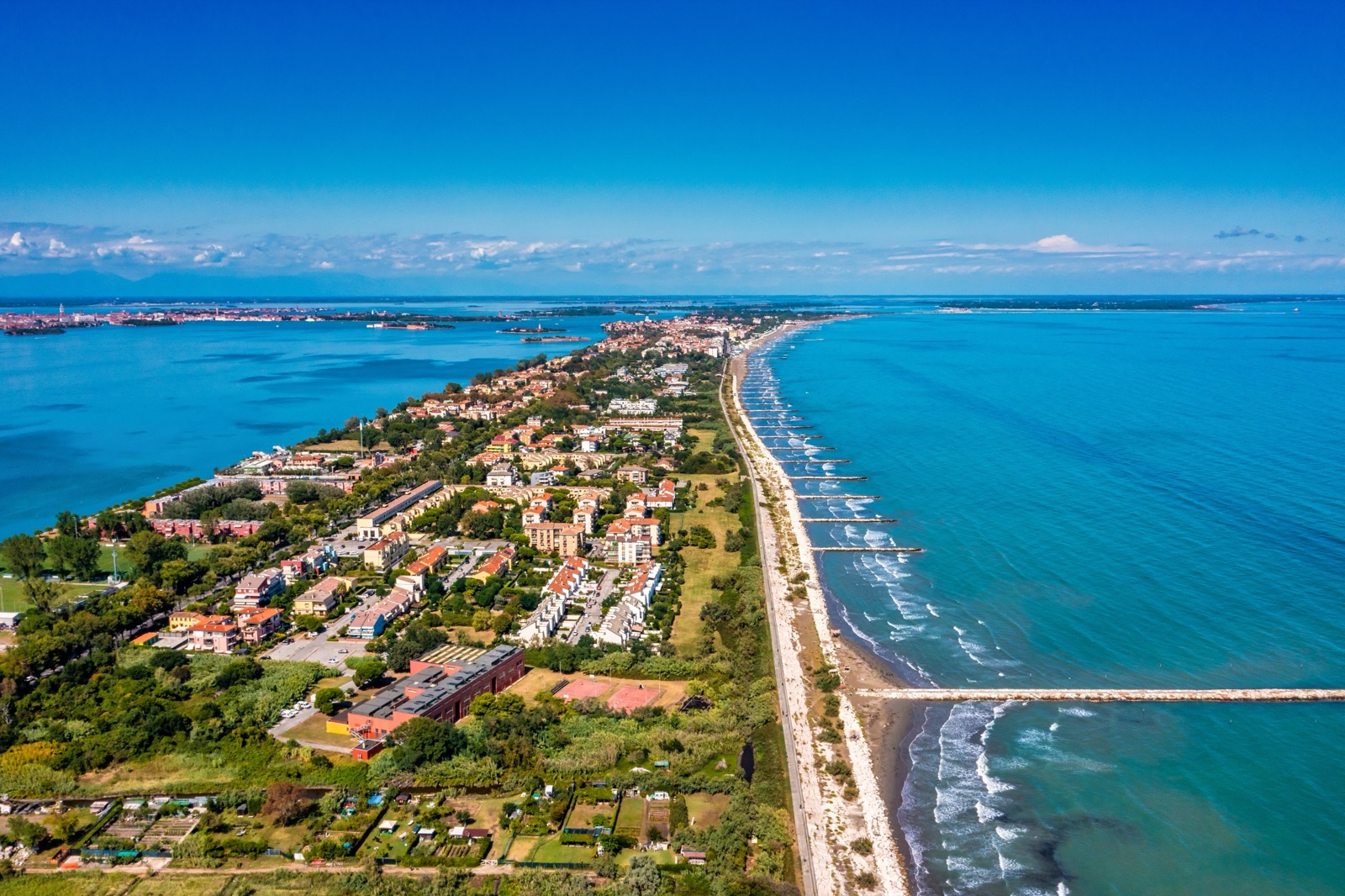
The Lido di Venezia is the long, thin barrier island that separates the Venetian lagoon from the Adriatic. It is Venice’s beach: sand along much of its seaward side, a resort town of Liberty-style villas and grand hotels at its northern end, and every late summer the Venice Film Festival. The water bus from San Marco lands at Santa Maria Elisabetta, and unlike the historic centre the island has roads, buses and cars.
It is not next door to Murano and Burano. Those lie north of Venice; the Lido lies south-east, across the basin from San Marco. The one direct boat between them is line 14, which runs from San Zaccaria via the Lido and Punta Sabbioni to Burano. This guide covers how to get there, the free and paid beaches, the festival and the hotels that made the Lido famous, and the flat ride south to Malamocco and the Alberoni dunes.
The Lido at a glance
- Size: an 11-kilometre barrier island in Wikipedia’s figure; the Lido’s own tourism site says 12 km. Either way, it is long and narrow.
- People: about 20,400 residents, which makes it a real town as well as a resort.
- Arrival points: the water bus lands at Santa Maria Elisabetta, the car ferry at San Nicolò.
- Beaches: hotel and private beaches in the town, with large public beaches towards the northern and southern ends.
- Villages: from the 12th to the 19th century, Malamocco was the only significant settlement on the island.
Getting there
Several vaporetto lines end at Lido S.M.E. (Santa Maria Elisabetta):
- Line 1 runs Piazzale Roma – Ferrovia – Rialto – San Marco – Lido S.M.E., stopping at every stop on the Grand Canal. It is the slow, scenic way.
- Line 5.1 loops Lido S.M.E. – Ospedale – Fondamente Nove – Ferrovia – Piazzale Roma – San Zaccaria – Lido S.M.E., and line 5.2 runs the same loop the other way.
- Line 14 runs San Marco-San Zaccaria – Lido S.M.E. – Punta Sabbioni – Burano.
- At night, line N runs Lido S.M.E. – Grand Canal – Giudecca Canal – San Zaccaria.
Drivers use the car ferry (ferry-boat) from Tronchetto, which lands at San Nicolò at the northern end of the island.
Tickets
The standard ACTV tickets work: a single costs €9.50 for 75 minutes, and passes run from €25 for 24 hours. Time tickets are valid on all land and water services, so the same ticket covers the Lido’s buses. For a simple beach day, the €16 beach return ticket covers a return trip on boat lines 14 and 15 between Venice, the Lido and Punta Sabbioni, plus the Lido buses except line 11; the return must be validated by 23:59 on the day you first use it. Our vaporetto guide explains validation, passes and luggage.
Bikes
The Lido is flat and has roads, so a bike is the best way to see it. Bicycles ride only on certain boat lines, including 11, 14 and 15, at €1.50 each, space and the captain permitting, and folding bikes in a bag within 150 cm travel free.
The beaches: free or stabilimento?
Much of the sand in the town belongs to hotels and bathing establishments (stabilimenti). The Lido’s seafront is known for its capanne, cabins with a veranda and awning used by several families, lined up in rows along the private beaches. On the equipped beaches you can rent umbrellas and sunbeds, with bars, showers and toilets. The water stays shallow for a long way, which suits families with children, and the Lido’s tourism site describes its beaches as Blue Flag beaches.
The free beaches
The city of Venice lists the Lido’s free beaches (spiagge libere), which it cleans through its waste company:
- San Nicolò, a protected area at the northern end, about 600 m from the breakwater.
- Lungomare D’Annunzio, a free stretch between Venezia Spiagge and the former Ospedale al Mare, in the town.
- The Murazzi, about 5 km of free beach along the stone sea wall south of the town.
- Alberoni, the free beach of the protected area at the southern tip, about 2.3 km long.
One former free beach has gone: the stretch in front of the old Ospedale al Mare has been leased to private operators since 2025.
The city’s routine cleaning of free beaches runs from 15 May to 15 September, every day from 6:00 to 12:00, and each free beach is cleaned at least once every 10 days. Driftwood and seaweed are left in place on purpose, as part of the coastal ecosystem, so do not expect a raked beach. In the protected areas, the recycling bins stand at the main access points rather than on the sand, so carry your rubbish back with you.
Sharing the dunes with birds
The San Nicolò and Alberoni beaches lie inside nature reserves where two small shorebirds, the little tern and the Kentish plover, lay their eggs. In the nesting season Lipu volunteers protect the nests on the dunes with nets, fences and signs. Keep outside the fenced areas and keep dogs on a lead.
Late in the season
In 2026, Venezia Spiagge, which runs the Bluemoon, Lungomare and San Nicolò beaches, keeps a late-season service going on Saturdays and Sundays from 10:00 to 18:00 until 31 October, weather permitting, with a single deckchair (no umbrella) for €5. Check before you go, as the offer depends on the weather and the date.
For emptier sand, go further south: Pellestrina, beyond the Malamocco inlet, has about 8 km of free beach and Murazzi and no bathing establishments at all.
The Venice Film Festival
The Venice International Film Festival is the oldest film festival in the world, and the Lido has been its home from the start. The first edition took place from 6 to 21 August 1932 on the terrace of the Hotel Excelsior, when forty films from six countries were shown. It became an annual event from 1935.
The festival’s headquarters, the Palazzo del Cinema on the seafront, was inaugurated on 10 August 1937 for the fifth edition. Its main screening theatre has 1,032 seats. By the early 1950s the festival already drew more than one hundred thousand spectators, and the building has been extended and altered several times since, most recently in a renovation between 2012 and 2015. Next door stands the Palazzo del Casinò, opened in 1938, whose monumental front contrasts with the plainer modernist lines of the Palazzo del Cinema.
The 2026 festival
The 83rd festival was held on the Lido from 2 to 12 September 2026, and La Biennale reports that it sold 117,656 tickets, 14% more than in 2025. Anyone can go, not just the film industry:
- Public screenings: the public has its own access to screenings, as shown in the daily programme.
- Prices: in 2026 a full-price ticket for a 3 pm screening in the Sala Grande cost €18, and one for the 7:30 pm screenings €50. Smaller theatres were cheaper: an afternoon seat at the PalaBiennale cost €15. Concessions are available to under-26s, over-65s and Biennale Card holders.
- Languages: films screen in their original languages with Italian and English subtitles.
- The red carpet: passage on the red carpet cannot be guaranteed.
The festival takes place in late August and early September. In 2026 subscriptions went on sale in July, so watch La Biennale’s site in early summer for the next edition.
From fortress to resort
For most of its history the Lido was a defence, not a playground. Until the nineteenth century its main role was military, guarding the Lido inlet, the widest entrance to the lagoon and the one closest to Venice. The island was thinly populated: in 1820 it had 814 inhabitants, 662 of them in Malamocco.
Lord Byron, who spent five years in Venice, liked to ride his horses on the Lido from a hut he rented at Alberoni. The resort itself began in the middle of the nineteenth century. In 1857 Giovanni Busetto, known as Fisola, opened a seaside resort of wooden cabins on piles over the beach. Tourist numbers rose from 80,000 in 1872 to 160,000 in 1883. In 1887 and 1888 the bathing resort was expanded again and the first beach huts were installed, the forerunners of today’s capanne, and in 1889 an electric tramway was introduced along the Gran Viale.
The grand hotels
The grand hotels followed at the start of the twentieth century.
- The Grand Hotel des Bains was built in 1900 to attract wealthy tourists. Thomas Mann stayed there in 1911, which inspired his novella Death in Venice, and Luchino Visconti’s film of the novella was shot there in 1971. Sergei Diaghilev died at the hotel in 1929. In 2010 it closed for a planned conversion into luxury apartments, and as of September 2024 the building was still awaiting renovation.
- The Hungaria Palace Hotel, later the Grand Hotel Ausonia & Hungaria, opened in 1907.
- The Hotel Excelsior opened in 1908, and its terrace hosted that first film festival in 1932.
The Lido also remembers the First World War: a votive temple dedicated to the Madonna of Victory, built between 1925 and 1928, holds the bodies of 3,700 soldiers.
To see the hotels, walk or ride from Santa Maria Elisabetta along the Gran Viale Santa Maria Elisabetta, about 700 m long, which crosses the town from the water-bus stop to the beach. The Des Bains, the Palazzo del Cinema and the Excelsior all face the seafront.
Cycling to Malamocco and Alberoni
The best half-day on the Lido is a ride to its southern tip. The Lido tourism site suggests a simple route from Piazzale Santa Maria Elisabetta, where the vaporetti land, to Alberoni, the southern tip of the Lido.
- Start: take the Gran Viale to the seafront, past the old Casinò, the Palazzo del Cinema and the Hotel Excelsior, then cut back to the lagoon side.
- To Malamocco: along Via Sandro Gallo the route continues for about 3.5 km, with lagoon views at each bridge, before reaching the village.
- To Alberoni: from Malamocco the path runs for about three and a half kilometres along the Murazzi sea wall to the Alberoni beach.
Malamocco
Malamocco is a village of calli and campi ringed by a canal, like Venice in miniature. Its history goes back to the earliest days of the lagoon: the older settlement of Metamaucum was once a bishop’s seat and a capital of the Duchy of Venice, and in 1116 it was submerged by an exceptional storm surge. A Metamaucum Nova, today’s Malamocco, is first recorded in 1107.
- What to see: the church of Santa Maria Assunta, the Palazzo del Podestà and the remains of an Austrian fort.
- What to eat: the village’s many vegetable gardens are known for their artichokes.
- Its famous resident: the cartoonist Hugo Pratt fell for Malamocco, took a house there and set several Corto Maltese stories in the village.
The Murazzi
South of Malamocco the Lido’s seaward side is protected by the Murazzi, a defensive sea wall of white Istrian stone standing 4.5 m above sea level. Building began in April 1744. The Lido section runs for five kilometres, between Ca’ Bianca and Alberoni; the Pellestrina section is 10 km long. The Murazzi gave way in 1966, in the high water that flooded Venice. Today a cycle and footpath runs beside the wall.
The Alberoni dunes
At the southern tip, the WWF Dune degli Alberoni oasis covers about 160 hectares of dunes and pinewood, with a wide beach where the Kentish plover still nests. It is about 9 km from the Lido centre, and it is open to visitors all year; spring to early summer and autumn are best for flowers and wildlife. Without a bike, take bus line A from Santa Maria Elisabetta. The golf course at Alberoni, next to the reserve, opened in 1930.
Going further
From Alberoni, line 11 continues by car ferry across to Santa Maria del Mare on Pellestrina, and on by bus and boat to Chioggia. The two-day Ciclovia delle isole di Venezia follows the same chain of islands from Chioggia via Pellestrina, Alberoni, Malamocco and the Lido to Punta Sabbioni and Cavallino-Treporti, 40 km in all. Touring bikes with wide tyres are recommended, because there are short unpaved stretches. Our guide to the Venice islands covers Pellestrina and the other lagoon islands in more detail.
San Nicolò and the Jewish cemetery
At the northern end of the island, where the car ferry lands, is San Nicolò. In 1386 the Jews of Venice were granted land here for their cemetery, next to the San Nicolò convent, and burials began in 1389. The free beach of the San Nicolò protected area lies beyond, facing the Lido inlet and the breakwater.
Combining the Lido with Murano and Burano
Because the Lido and the northern islands lie in opposite directions from Venice, most visitors give them separate days. If you want both in one day:
- Morning: line 12 from Fondamente Nove to Murano and Burano.
- Afternoon: line 14 from Burano via Punta Sabbioni to the Lido, for a late swim or a ride along the seafront.
- Evening: line 1 or 5.1 back to Venice.
A 24-hour pass at €25 covers all of it. Alternatively, a guided tour by private boat covers Murano’s glass and Burano’s lace-makers and painted houses in about 5 hours, leaving the rest of the day for the Lido. The tours page lists what is available on your dates, and our guide to getting to Murano and Burano covers the northern lines in detail.
When to go
- Beach season: the stabilimenti open for the summer, and the city’s routine beach cleaning runs from 15 May to 15 September.
- Festival time: late August and early September, when the seafront is at its busiest.
- Spring and autumn: best for the Alberoni dunes, for cycling and for quiet.
Frequently asked questions
How do I get to the Lido from Venice?
Take line 1 from Piazzale Roma down the Grand Canal, line 5.1 or 5.2 from the station or Fondamente Nove, or line 14 from San Zaccaria. All stop at Lido S.M.E. (Santa Maria Elisabetta), a short walk from the beach along the Gran Viale.
Are the Lido beaches free?
Some are. The city lists free beaches at San Nicolò, on a stretch of Lungomare D’Annunzio, along the Murazzi and at Alberoni. Much of the beach in the town belongs to hotels and stabilimenti, which rent capanne, umbrellas and sunbeds.
Can I go to the Venice Film Festival without accreditation?
Yes. The public has its own screenings with tickets on sale online; in 2026 a Sala Grande ticket cost from €18 to €50 depending on the time. Films are shown with Italian and English subtitles, but passage on the red carpet cannot be guaranteed.
How far is it to cycle to Alberoni?
The WWF oasis at Alberoni is about 9 km from the Lido centre. The Lido tourism site’s route runs about 3.5 km along Via Sandro Gallo to Malamocco, then about three and a half kilometres along the Murazzi to the Alberoni beach.
Which is the Death in Venice hotel?
The Grand Hotel des Bains on the Lido. Thomas Mann’s stay there in 1911 inspired the novella, and Visconti’s film was shot there in 1971. The hotel closed in 2010 for a planned conversion into apartments.
Can I combine the Lido with Murano and Burano?
Yes, with a 24-hour pass. Take line 12 to Murano and Burano in the morning, then line 14 from Burano to the Lido in the afternoon.